 Little Rock Radio
The Local Desk • Arkansas Issue 3
On November 3, Arkansans will be asked to rewrite a piece of the state constitution so government can do more of what it already does poorly.
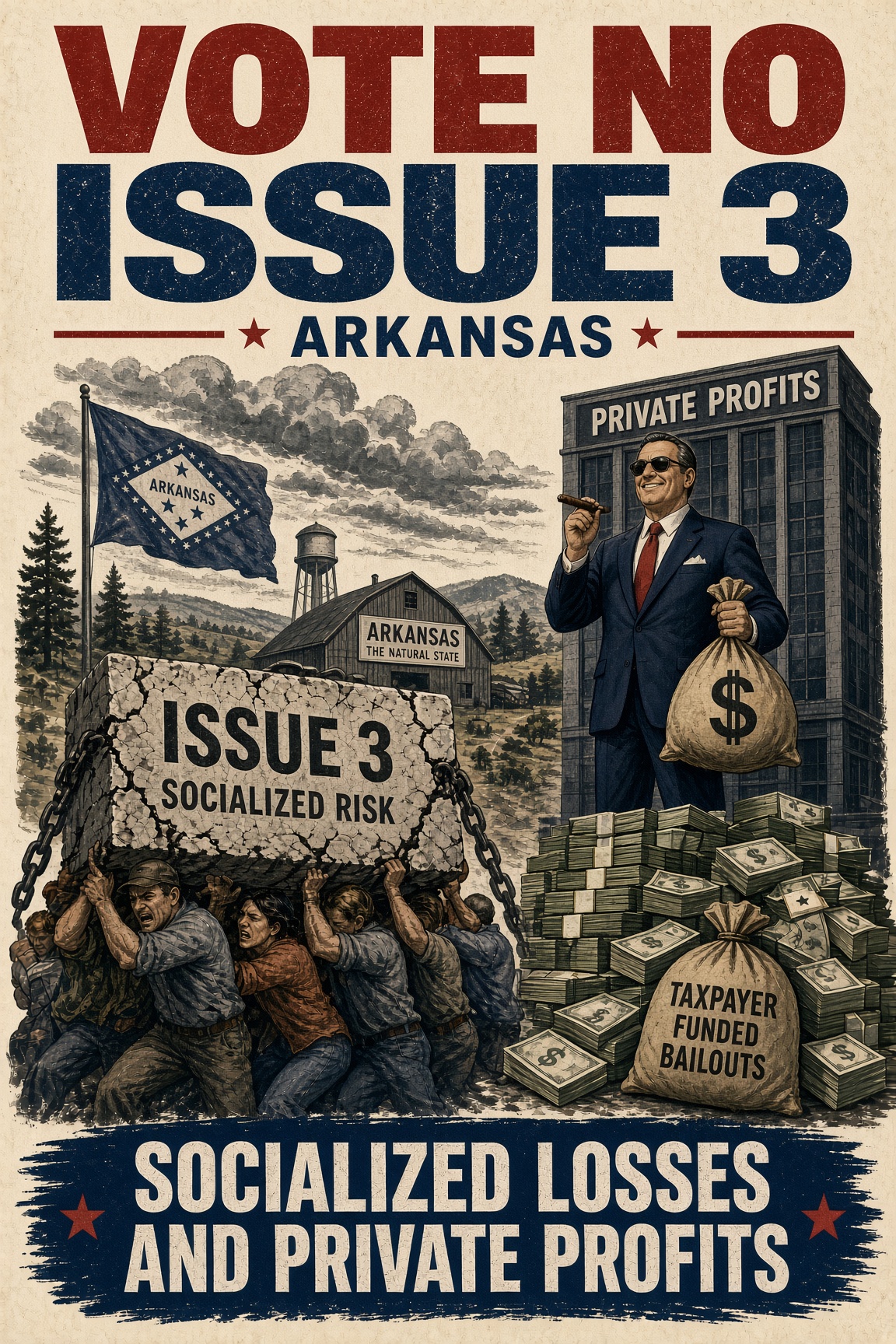
On November 3, Arkansans will be asked to rewrite a piece of the state constitution so government can do more of what it already does poorly: pick private winners, shift the bill onto the public, and call it economic development.
Issue 3 is sold as a local “tool.” Read the amendment and it is something else. It would let the General Assembly create programs that spend public money on loans and grants. It would let cities, counties, or multi-government “cooperative areas” form economic development districts. Property inside a district can come off the regular school, city, and county tax rolls. The district can levy its own charges. It can issue bonds that do not count against ordinary local debt limits. Local governments can fund the district or lend it credit. The amendment itself creates no project and writes almost none of the operating rules. Those come later, after the constitution has already been opened.
That sequence is the tell. Voters are asked to remove the guardrails first and trust the details to a future session and to boards that have not been designed yet.
The short version. Private owners keep the land, the building, and the upside. If the project fails, the remaining tax base still pays for the sheriff, the roads, and the schools that lost the parcel. Taxpayers outside the fence do not share the profit. That is socialized loss and private profit in one sentence.
Arkansas already forbids cities and counties from becoming stockholders in private companies or lending them credit. That rule is not a quirk. It is a hard-learned limit on using the public balance sheet as a private piggy bank. Issue 3 carves a wide exception and then says that conflicting constitutional language and court rulings are superseded.
Follow the money through a finished district:
The private owner keeps the land, the building, and the going concern. If the grocery store, warehouse, or mixed-use project works, the equity stays private. If it does not, the remaining tax base still has to pay for the sheriff, the roads, and the schools that lost the parcel. Bondholders may have a claim on district revenues. Taxpayers outside the fence do not get a share of the upside.
Supporters say neighboring states already do this, and that Arkansas cannot compete for retail, housing, and entertainment without matching their incentives. The honest version of that argument is narrower: developers cannot extract the same public package here that they can extract in Texas or Oklahoma. “Compete” in this context often means “join the bidding war.” Studies of firm-specific incentives keep finding the same pattern. A large share of subsidized projects were coming anyway. Politically connected firms are more likely to win awards. States pay enormous sums per claimed job. Kansas and Missouri spent years raiding each other across the state line and bought almost nothing that looks like prosperity.
Issue 3 would also let richer cities outbid poorer ones inside Arkansas. A district in a growing metro can offer a fatter package than a Delta town that actually needs the grocery store. That is not a development strategy for the whole state. It is a mechanism for concentrating the next deal where the tax base and the lobbyists already are.
Arkansas has walked this road. Voters passed Amendment 78 in 2000 for similar reasons. Courts later stripped out the parts that made it useful to dealmakers. Issue 3 is the do-over: put the authority in the constitution so the next lawsuit has less to stand on. Putting a subsidy machine in the constitution is not “flexibility.” It is an attempt to make the machine hard to dismantle.
It is a mystery only if you ignore who wants the amendment.
The legislature referred Issue 3 in 2025. The public campaign for it is run by Arkansans for Strong Communities, tied to the State Chamber. Early filings showed six-figure support from chamber groups, economic developers, and contractors. That is not a scandal by itself. It is a map. The people who collect the subsidy, build the project, or get paid to recruit the project are the people paying to change the constitution.
Arkansas already limits what a donor can give a candidate. It does not put a meaningful ceiling on independent spending, and ballot committees can take large checks from the industries that will live inside the new districts. Contribution limits on campaigns are a speed bump. They are not a wall between public power and private return. Independent expenditures sit outside the candidate limit by design. So the legal form is clean: no one has to write a check to a senator the week before a vote if they can fund the “education” campaign that makes the vote look like common sense.
Issue 3 then completes the circuit. Once the constitution allows grants, tax carve-outs, and off-books district debt, the valuable thing is no longer just access to a legislator. It is access to the board that draws the map, sets the assessment, and names the project. Appointed districts are harder for voters to punish than a mayor. That is not an accident of drafting. It is how the risk is moved off the people who profit.
Saying no to Issue 3 is necessary. It is not sufficient. A state that only blocks bad tools still has a real problem: capital is uneven, rural towns lose grocery stores, housing is tight in the places that are growing, and every session produces another incentive package because incentive packages are what the current machine knows how to build.
If the only answer is “stop helping business,” the yes campaign wins the argument on mood even when it loses on evidence. The alternative has to do two things at once. It has to change who the political system is for. And it has to change how public money enters the private economy.
That is campaign finance reform and public banking. They are not slogans from different worlds. One decides who writes the rules. The other decides whether public capital comes back.
A serious Arkansas reform would treat development policy as a conflict-of-interest problem, not a branding problem.
Start with the obvious holes. Independent expenditures should not be a second campaign account with no lid. Ballot-measure committees that exist to change the tax code or the constitution should face the same sunlight and the same aggregation rules as candidate committees, including the true source of funds when a chamber or contractor PAC is a pass-through. Pay-to-play rules should bar campaign money from firms that are bidding for, or sitting inside, a public incentive deal during the window of the deal. Officials who vote to create a district, and appointees who sit on its board, should have cooling-off periods before they can work for the developer that received the abatement.
None of that requires a new theory of democracy. It requires admitting that Issue 3 is not a debate between “pro-growth” and “anti-growth.” It is a debate about whether the people who harvest public tax capacity should also be allowed to purchase the amendment that legalizes the harvest.
Reform will be called “politics.” The current system is already politics. It is just politics with a better press release.
The other half of the answer is the structure of the money.
A grant is a gift. A tax exemption is a gift that repeats every year. A district bond that does not count against debt limits is a gift of borrowing capacity. A public bank is not a gift. It is a lender owned by the public, funded first by public deposits, that is supposed to earn a return and keep the residual.
North Dakota built that institution in 1919. The Bank of North Dakota holds state deposits, partners with community banks on loans those banks cannot hold alone, and sends profits to capital, mission programs, and the state’s general fund. It does not run a retail branch network that tries to put local banks out of business. The core product is credit that must be repaid. The state is the shareholder. That is the opposite of Issue 3’s core product, which is a carve-out whose leftover equity stays private.
This is not a romance. North Dakota still uses tax abatements. It still has TIF. Its homeownership rate is among the lowest in the country, in the low sixties. Its rents are among the lowest. Its unemployment rate in August 2026 was 2.2 percent, second only to South Dakota. The public bank did not produce a suburban ownership utopia. It did produce a public balance sheet that can partner on farm, small-business, school, and infrastructure credit without first punching a hole in the school district’s tax base.
Arkansas should study that model and also study its own history. The state’s first generation of public banks, the State Bank and the Real Estate Bank of the 1830s, were captured by planters and politicians and failed. That is the warning label, not the reason to refuse the idea. North Dakota’s bank survived because it was forced, over a century, into a partnership model with professional underwriting and a narrow mandate. A modern Arkansas public bank should be chartered the same way: state deposits as the base, no retail war with community banks, loans rather than grants as the default, published underwriting standards, and a board that cannot be a landing pad for the same developers who want Issue 3.
Used correctly, the bank becomes the place idle public money works before it is spent. Cities that need a grocery store or a rehabbed block would bring a deal to a local lender. The public bank could take a participation, buy down a rate on transparent terms, or finance the public piece — water, street, demolition — as a loan against a real revenue source. The private owner would still own the store. The public would still own the credit. If the project works, both sides keep what belongs to them. If it fails, the loss hits a loan book that was built to take credit risk, not a third-grade classroom’s millage.
That is the line Issue 3 erases.
Campaign finance reform without a public bank leaves honest legislators with only the Chamber’s toolkit. A public bank without campaign finance reform becomes another trough. Together they change the incentive.
If a developer cannot buy the constitutional amendment, cannot sit on the district board, and cannot convert a political gift into a tax-free parcel, the remaining honest request is credit. Credit is what a public bank is for. If a town cannot outbid Bentonville with an exemption, it can still finance infrastructure at cost and let the private project stand on its own numbers. That is a harder sell in a ribbon-cutting. It is a better deal for the people who were not in the room.
Issue 3 asks voters to constitutionalize the worse model because the better model has no lobby. Banks that already hold public deposits do not want a public competitor for those deposits. Developers do not want to repay what they can be given. Chambers do not want a world where “economic development” means underwriting instead of incentives. That coalition is not evil. It is rational. The public has to be equally rational.
Vote against Issue 3. A constitution is the wrong place to park a subsidy program whose rules have not been written. “Trust us, we’ll fill it in later” is how tax capacity disappears and accountability gets appointed.
Then treat the no vote as a beginning. Demand a campaign-finance package that closes independent-expenditure and ballot-committee loopholes and builds pay-to-play walls around incentive deals. Demand a public-bank feasibility statute with a real mandate: hold state funds, partner with Arkansas community banks, publish results, and forbid the 1836 error of turning the bank into a private club with a public seal.
Problems without solutions curdle into cynicism. Issue 3 is not proof that Arkansas cannot build anything. It is proof that the current builders prefer a tool that socializes the downside. Take the tool away. Put a bank and a clean election law in its place. That is not hopelessness. That is the work.
Want this desk to take another statewide question? Email mailbox@littlerockradio.com with the measure and a short note.